Product / Expert playbooks
The method, written down. And visible before it runs.
Anyone can ask an AI for a site score. The question that matters is what it measured, how it weighted it, and what would have disqualified the site regardless. A playbook answers all three, in the open.
- Nineteen playbooks
- It asks before it runs one
- The weights and thresholds are visible
01 / What is in one
A playbook is not a prompt. It is a method.
The difference is that a method can be inspected, argued with, and used again next quarter and get the same treatment.
- 01
Scope and guardrails
What this method is for, and what it refuses. Ask the senior-housing playbook about memory care and it stops, rather than guessing.
- 02
Data source priority
A cascade, in order. Your web map first, then the trusted sources, then the public ones, and only then the open web.
- 03
The scoring rubric
The factors, their weights, and what each one is actually measuring. In the open, where you can argue with it.
- 04
Thresholds
What counts as excellent, good, fair, poor. Named numbers, not a vibe.
- 05
The method, step by step
Numbered, with the exact tools each step calls, so the same question runs the same way twice.
- 06
Red flags
The disqualifiers that override a good score. A great trade area with the wrong parcel is still the wrong parcel.
- 07
Clarifying questions
The things it must ask before it can answer honestly. It asks them rather than assuming.
- 08
The deliverable
What comes out, in what shape, with a methodology section and the vintage of every number.
From the childcare playbook
The scoring rubric, as it is actually written.
- Demographic demand 28%
Kids 0-5, split into 0-2 and 3-5
- Income and private-pay capacity 18%
The gate-keeper for tier
- Competition and whitespace 18%
Child-to-licensed-slot ratio
- Commute capture and access 14%
The home-to-work corridor
and the rest
Thresholds
02 / Written by people who have done it
You can tell in one paragraph whether a method has been near the work.
These are lifted from the childcare playbook, unedited. Read them and decide for yourself whether a general model would have known.
“Childcare is a trip-chaining business. Parents drop off on the way to work, not from home. A site two miles off the dominant home-to-work corridor will lose enrollments to a site directly on the corridor, even if the off-corridor site is closer to the family’s home.”
“The community tier treats a $65K median household income trade area as strong. The premium tier treats it as weak. Same address, opposite verdict.”
Nineteen playbooks ship with Curated. Some are a page. The ones for childcare and active adult are the deepest things we have written, and they are the honest measure of what a playbook can be.
03 / It asks first
No method runs behind your back.
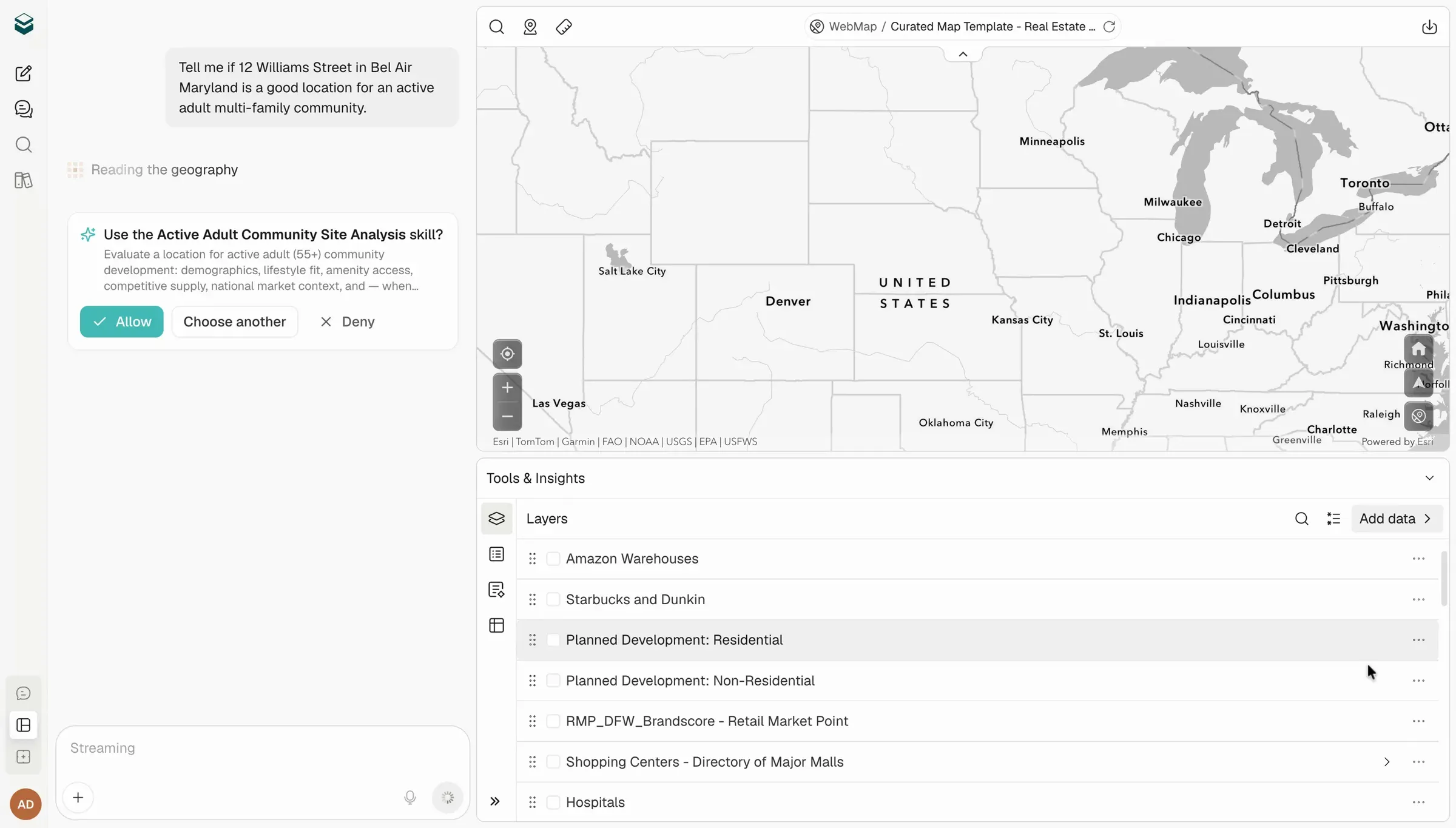
When Curated decides a question deserves a playbook, it stops and tells you which one. The turn genuinely pauses. Nothing happens until you answer.
Allow it, swap it for a different playbook, or refuse. If you refuse, it says so and asks what you would rather it did.
You can also pick the method yourself before you ask. Type a slash and choose.
04 / It would rather ask than guess
The most useful thing a method can do is refuse.
It refuses questions outside its scope
Ask the active-adult playbook about memory care and it stops, rather than producing something that sounds right.
It refuses to hardcode a benchmark
The playbooks are written with a standing instruction: numbers drift, and a stale number produces a confidently wrong answer.
It questions its own score
On a low score it opens a conversation rather than issuing a verdict. There may be something true that is not in the data.
“This scored lower than you might expect. Is that surprising, or does it match your instinct? There may be factors that are not in the data.”
05 / When yours is not on the list
Then the playbook we write is the one you already run.
Somewhere in your organization is the person everyone trusts to call it. We sit with them, work out how they actually weigh the decision, and encode it so the rest of the team can run it the same way on a Tuesday afternoon.
What comes out belongs to you. It is your judgement made repeatable, not ours imposed on you. It is also how most of the playbooks on this page came to exist.
How we scope it
We will not quote you a timeline before we understand the decision.
Some methods are a week of work. Some are a quarter, because the thing you are deciding is genuinely hard. A vendor who gives you the same answer for both has not asked what you do.
06 / All nineteen
Eight know your industry. Eleven do not need to.
Where to go next, who is already there, what to charge, and what the storm is about to do to it. Those questions look the same whether you run clinics or car washes.
By industry
Each one has a page
By decision
Runs in any industry
-
Site analysis
Any location, judged on demographics, accessibility, competition and risk. The one to reach for when no vertical playbook fits.
-
Market analysis
A metro, county or submarket, read for opportunity and trend, and compared against its peers.
-
Market scan
Find the best area, not the best address. Returns a scored surface across a whole region that you drill into, again and again, until you have a site.
-
Expansion
Where to grow next, weighed against the locations you already run, so the new one does not eat the old one.
-
Competition
Who else is here, how close, and how much of the demand they are already taking.
-
Pricing
A defensible price band, floor to target to stretch, anchored in fresh comps and in what the location itself is telling you.
-
Spatial analysis
The cross-layer question. What falls inside this boundary, how many of them, and what exactly is at this coordinate.
-
Weather and emergency
A live warning polygon, turned into population at risk, critical facilities, infrastructure and social vulnerability.
-
Engagement
Programming, collaborations and promotions for a place, and an honest list of the assets worth building.
-
Marketing content
Publish-ready posts and email copy, with a generated hero image, tuned to the segment that actually lives around the site.
-
PlaceStory™
The chapter-based location narrative, built through a guided conversation rather than a single prompt.
07 / Who reaches for it
The same playbook, three very different people.
The person who has to decide
Ask the question in the words you would use in the meeting, and get an answer you can defend in it. No ticket, no queue, no waiting until Thursday.
The GIS team
Stop being the request queue for questions that were never interesting. Curated works inside the permissions and the layers you already govern, and you stay in charge of both.
For GIS teamsThe operator
The regional manager who wants to know why one location outperforms another can ask, and get a real answer rather than a guess dressed up as one.
08 / On the way
Next, the playbook becomes yours.
Today a playbook is ours and you can see what it does. The interesting part is what happens when you can change it.
In development
See the playbook before it runs
A reader for the method, the rubric and the thresholds, so you can inspect it rather than take our word for it.
Fork it and tune the weights
Take an official playbook, copy it, and change what it measures to match how your firm actually decides.
Score from the rubric, not from prose
Move the arithmetic out of the model and into the rubric itself, so the same site scores the same way every time.
Until then, if the method for your vertical does not exist, we write it with your team, from the way you already decide. That is how most of these came to exist.
The questions that come up before the first analysis.
-
Does Curated just run a playbook without telling us?
No. When it decides a playbook fits your question, it says which one and waits. You can let it run, send it to a different playbook, or tell it not to use one at all. The methodology is never something that happened to your analysis without you knowing.
-
Can we have a playbook built to our own methodology?
Yes, and it is the part of this we care most about. We sit with the analysts who already make the decision well, work out how they actually weigh it, and encode that so the rest of the organization can run it. What comes out is yours. We will scope the effort honestly rather than quote you a number before we understand the decision.
-
Do we need GIS expertise to use one?
No. The point is that everybody gets a GIS analyst, not that everybody becomes one. You ask in plain language and the map and the answer arrive together. Your GIS team stays in the loop for governance and for the layers only they can build.
-
How is a playbook different from a dashboard?
A dashboard answers the questions you already knew to ask, and somebody had to build it first. A playbook answers the question you are asking now, runs the spatial analysis underneath it, and shows you the method it used. When the question changes, you do not file a ticket for a new dashboard.
Bring your methodology. We will show you it running.
The fastest way to judge a playbook is to compare it against how your own team already decides, and see where it agrees with you and where it does not.
Twenty minutes, and you can argue with the method.